

SEM Sound Studies Gaming Session 2026
Updated: Sep 27
Dear SEM members,
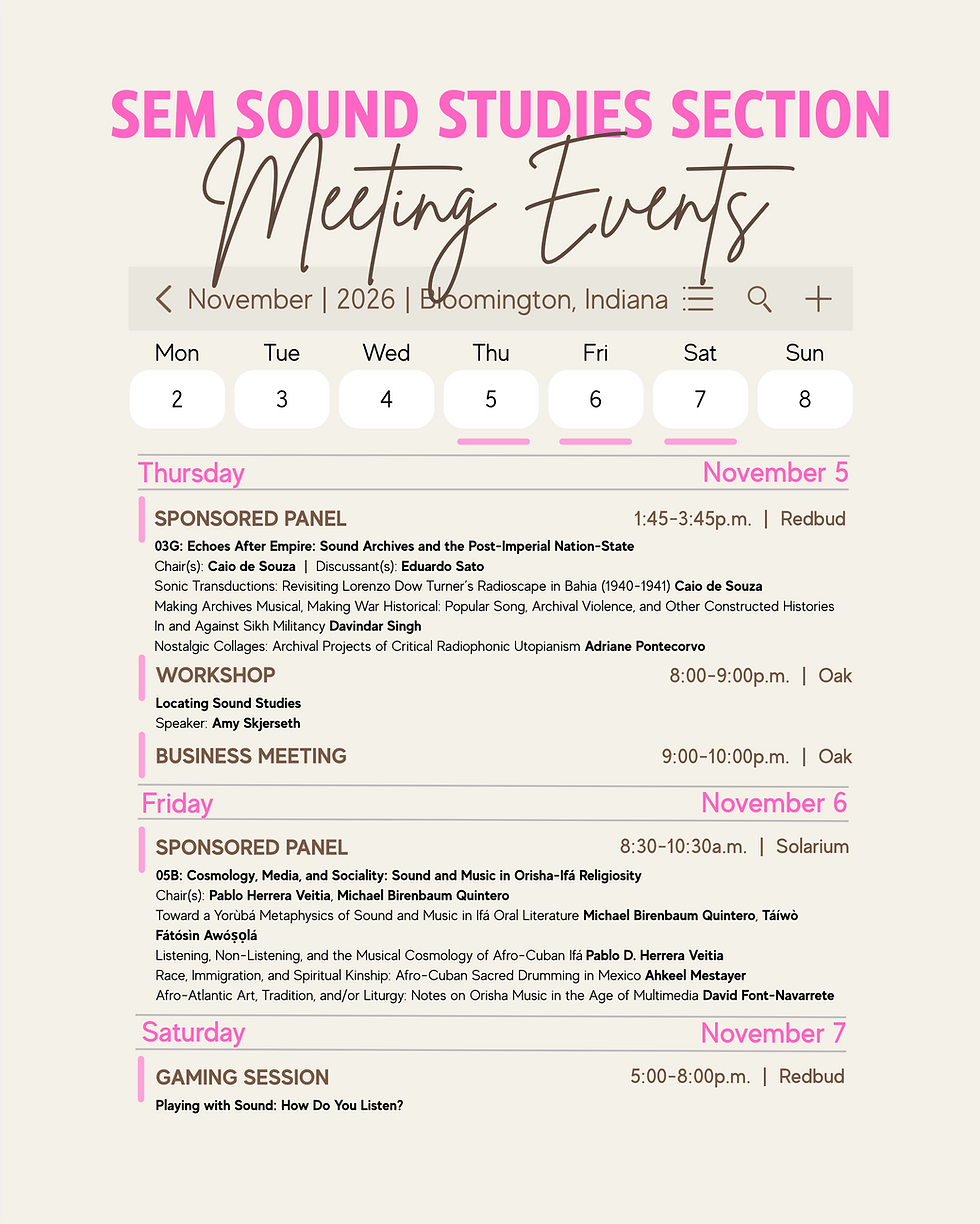
The SEM Sound Studies Section invites you to attend our first-ever gaming session, “Playing with Sound: How Do You Listen?” on Saturday, November 7, from 5 to 8 p.m. The meeting provides an interactive gaming space that brings together participatory scores, improvisation, role-play, and collaborative sound-making. Through play, we aim to explore how gaming can transform listening into a situated, embodied form of knowledge. Participants will explore inquiry, affect, contingency, relationality, and failure - factors that make sound both a medium and a method. Open to all possible sonic encounters, musical and nonmusical experience alike, the session welcomes gamers to listen with and through others, experiment ethnographically, and discover new possibilities for understanding sound, social connection, and collective creativity.
Please see the program below. We look forward to enjoying a fun evening of gaming with you! More annual events will be announced soon. Please stay tuned!


Abstracts and Bios
“Unmerging” and “Greetings”
“Unmerging” and “Greetings” are two participatory event scores that invite participants to explore protocols of relationality. I'd be happy to lead players in either or both.
In “Unmerging,” players sit in a circle singing wandering melodic phrases, seeking moments of harmonic contact with another voice, attending to the moment when the encounter tips catastrophically into oneness, and offering a vocal path back into relational distance. It explores the experiential edge between relation with an Other and the horror of an oppressive totality.
In “Greetings,” players circulate through a room in two roles: either as Greeters extending unanswered hellos or Ignorers resisting relation. Greeters seek to evoke any flicker of recognition: a grunt, a smile, a returned glance. "Greetings" highlights the great attentional effort required by turning away from relationality (or what is sometimes called "irrelationality.") It's worth noting that "Greetings" has something like victory conditions: one or more ignorers can "survive" the barrage of greetings, or everyone can be transformed into a Greeter. Either result typically results in laughter.
Both of these pieces come out of an urge to playfully explore the otherwise austere ethical philosophy of Emmanuel Levinas. My hope is to enter this ethical world in a spirit of ethnographic experimentation rather than grave obedience. Both explore how rapport is built and unbuilt, the coercive force of totalizing unity, and the cost of irrelational solitude. Performed together, the two pieces reveal the deep ethical stakes of listening and relational voice.
Matthew Rahaim is an ethnomusicologist and composer. His musical training is grounded in the Gwalior lineage of Hindustani music. His recent book Ways of Voice is an investigation of traditions of voice cultivation and ethical self-work in the Hindustani vocal ecumene, from Bollywood to Qawwali to Sufi Pop. His first book Musicking Bodies is about gesture in raga music. Other essays include speculative work in voice studies, gesture, raga theory, relationality, and the metaphysics of participation.
Matthew's recent compositions and installations have appeared at the Modulus Festival, the Wakpa Triennial, Drone Not Drones, and The Great Beyond. Matthew's project Resonant Transmutations features a suite of newly composed pieces for instruments crafted by Pedram Baldari out of decommissioned police rifles. He is currently working on a collection of text scores that experiment with relational protocols, called Improvising Relationality.
——
Communion (for Four Strangers)
Part audiovisual performance piece, part assemblage, part game, and part ritual, Communion (for Four Strangers) is a practice of effective listening and communication. Four strangers gather around a projected image on the floor, and are provided three handbells each, randomly chosen beforehand, and without any notation markings. The goal of the game to collectively create a piece of music without any communication by the participants outside of ringing the handbells. The resulting piece demonstrates each participant ’s ability to deeply listen and respond appropriately and creatively to what the other three are doing. To amplify the experience, the handbells will be mic’ed and digitally processed, creating an ambient soundscape, and the projected image on the ground will respond visually to the sounds made by the handbells. While envisioned for strangers, the piece may prove therapeutic to anyone grappling with communication challenges. No musical experience required for the game; low lightning needed.
Ben Dumbauld received his PhD in Ethnomusicology from CUNY Graduate Center, where he studied music, performance, and political ritual in Romania under Ceaușescu. His interest in performance and ritual has translated into his work as a percussionist and a composer. His compositions are noted for their aleatoric and improvised approach, framed more around prescribed performer positions and movements and mise-en-scène directions than traditional notation. Ben also regularly facilitates communal performance “rituals” around Pittsburgh, where he lives. Professionally, Ben works in K-12 Education as the Director of Curriculum and Instruction at TeachRock.org. A forthcoming article & lesson plan he co-authored with Raynetta Wiggins-Jackson will be published in The Palgrave Companion to Global Music History Pedagogy, edited by Gavin S. K. Lee.
——
Roll for Sound
Roll for Sound is a 1-page RPG — System Inspired by Roll for Shoes (Ben Wray), HAVOC (Grant Howitt), and Ædena (Brendan Conway).
1) Say what you do and roll 1d6 + a number of d6s equal to the level of the most relevant skill.
2) If the sum of 5s and 6s you roll meets the threshold for this check, you succeed.
3) You start with three level 1 skills: Each skill must be a single sound word, or short sound phrase (e.g. Song Titles [“Thunderstruck,”], Onomatopoeia [Fwip!], Genre, [Funk], description [babbling], or instrument [Tuba, etc]).
4) If you roll all 5s and/or 6s on a skill check, you get a new skill specific to the action (e.g. If you used the skill “Tuba 1”, and roll three 5s and/or 6s, you could gain the skill “Polka 2”)
The goal of the game is to improvise a story using sound as the method for advancement, and stretch our considerations of how the semiotics of sound shift and change meaning. Skills such as “Thunderstruck 1” could evoke many different connections including genre, vocalization, and artist, but can also semiotically connect to onomatopoeia or popular culture.
In addition to the role-play improvisation of the participants, players are encouraged to contribute to a collaborative sound object in the form of a playlist inspired by the skills gathered in-game. Using a music streaming platform, players can share what sounds they associate with what was played; these can be shared with the rest of the study group to demonstrate how understanding and meaning shifts through play.
Andrew Borecky earned his Ph.D. in musicology from the University of North Carolina at Chapel Hill. His research focuses on the role of sound in tabletop roleplaying games (TTRPG). He has conducted ethnographic and archival research throughout the United States, including a fellowship at the Strong National Museum of Play, and presents his research at both music and game studies conferences annually.
Isaiah Green is a Ph.D. candidate in ethnomusicology and folklore at Indiana University, where he is completing a dissertation focused on sound and spiritual ecology in Appalachia in response to climate crises. He has presented his research at conferences across the United States and currently resides in Knoxville, TN.
——
DoongDoong.club is an interactive, browser-based musical game that invites players into a shared virtual soundscape built on Korean onomatopoeic and mimetic words. Within a vast, disc-shaped virtual space, players place expressive, emoji-like objects that trigger spoken-word recordings as a radial scanner sweeps across the surface, transforming collaborative play into emergent polyrhythmic compositions.
At its core, the game serves as an experimental space for examining the friction and resonance between global and local modes of meaning-making. By pairing the universally recognized, flattened visual lexicon of internet emojis with culturally specific, phonetically rich Korean sound symbolism, DoongDoong.club complicates straightforward linguistic delivery. Players negotiate how familiar global iconography translates into distinct vocal textures, accents, and rhythmic gestures. Set against a visual environment blending Y2K nostalgia with retro-futurism, the platform invites participants to experience how cultural sonic memory, digital semiotics, and spatialized loop mechanics converge in contemporary participatory sound art.
BunniNeoki is a South Korea based sound·media art collective formed with media artist Dayoung Lee and sound researcher Chaeryeong Oh. They explore new multi-sensory experiences at the intersection of technology, language, and sound. They engage in artistic practice by using technology to expand human senses and networks, fostering interaction among participants across national and cultural backgrounds.
Dayoung Lee is a media artist, educator, and a HCI scholar whose research is based on tech-mediated augmentation of human senses and cognition. They are exploring advanced media discourses on how life and technology, and the virtual and the real, relate to one another in the Ph.D. program in Art & Technology at Sogang University.
Chaeryeong Oh is a Korean interdisciplinary researcher-artist. Primarily using web-based technical environment, they stage a critical inquiry of Euro-American hetero-masculine technological imaginaries, firmly grounded in queer, sound, and postcolonial theory.
——
Common Ground
Common Ground is a set of physical games for four or more participants using identical commonplace objects such as ceramic bowls, metal cups, chopsticks, coins or polystyrene hoops. The work uses principles of interdependence and emergence to sonically articulate shifting social relations, following the historical lead of Christian Wolff, Pauline Oliveros and others.
The action takes place on any floor or ground surface. Participants form geometric patterns, such as simple yet shifting triangulation shapes, and use the objects/sound sources to sound out their relationship to other players. The resulting sounds range from brittle sustained tones to clattering noise clusters.
There are options for the specific game/s played at this event depending on the curatorial outlook and the materiality of the space, whether a singular iteration for players using their feet to drag ceramic bowls across a concrete floor, or playing several of the games consecutively or concurrently.
Common Ground premiered as one of three Games and Actions for City of Sydney in 2015, followed by iterations for Orange County Museum of Art’s California Pacific Triennial in 2017 and for University of Technology Sydney, Ensemble Offspring and Museum of Contemporary Art Australia in 2018. It continues to evolve as an open methodology for group dynamics.
The work is, in turn, part of Games People Play, an expanding workbook of socio-sonic games by myself, Julian Day, in collaboration with and/or with input from various peers such as Luke Jaaniste, Zubin Kanga, Neil Luck, Janet McKay, members of Ensemble Offspring and community participants.
Julian Day is an Australian artist, composer, writer and broadcaster based in New York. Their artistic work has featured at Museum of Modern Art, MATA, Bang on a Can Marathon, MASS MoCA, Tate Modern, Whitechapel Gallery, Royal Academy of Music, Huddersfield Contemporary Music Festival, Australian Centre for Contemporary Art, Queensland Art Gallery of Modern Art, Institute of Modern Art, Sydney Opera House and Liquid Architecture. Day has presented programs and features for BBC and ABC radio for whom they have interviewed such artists as Vito Acconci, Janet Cardiff, Lydia Lunch, Blixa Bargeld, Laurie Anderson, Ryoji Ikeda and Liza Lim. They have given presentations at Harvard University, University of California, Los Angeles, New York University and Goldsmiths and published in Tempo, TURBA, Contemporary Music Review and Leonardo Music Journal. Day studied sound and visual arts at Columbia University and University of Oxford and is currently undertaking a PhD at Yale University.
Warmly,
SSS Executive Committee


Comments